Agriculture has been the livelihood of the majority of the Indians. The sphere of farming is also subject to weather conditions, and farmers usually experience financial losses because of natural disasters, increased costs, excessive prices of seeds and fertilizers, and water and irrigation issues. Under such an instance, Pradhan Mantri Kisan Samman Nidhi Yojana was initiated in giving a certain relief in the form of financial aid to the farmers. This scheme is considered to be one of the most popular and reliable schemes of the Central Government as it transfers the funds directly to the bank accounts of farmers and the whole system is seen to be entirely transparent.
Today, we will explain every detail related to the 21st installment of this scheme in very simple language so that no farmer faces any problems.
What is PM Kisan Samman Nidhi and why is it important?
The Pradhan Mantri Kisan Samman Nidhi Yojana was launched for farmers who have limited agricultural land and whose income is not very high. The government provides financial assistance of ₹6,000 to such farmers every year. This amount is not given all at once but is sent in three installments.
Each installment is ₹2,000 and is directly transferred to the farmer’s bank account through DBT (Direct Benefit Transfer). This eliminates any middlemen and ensures the entire amount reaches the farmer safely.
This payment is awaited by millions of small and marginal farmers in the country since farming has now been costly undertaking. The cost of seeds, fertilizer, pesticides, labor, tractor diesel, and irrigation are all costly. This installment is awaited by many farmers who then get time to prepare the next crop on time.
Why is this installment so important for farmers?
Many people think that ₹2,000 is not a large sum. However, for small farmers, this amount is crucial. For example:
- Many farmers use this money to buy seeds
- Some farmers use it to buy urea, DAP, or other fertilizers
- Some farmers spend it on pesticides or medicines
- Some farmers use it for other minor farm expenses
In villages, this money often arrives at a time when farmers need to make immediate expenses. This is why this money is of vital importance. This is why there is great anticipation and excitement among farmer brothers and sisters regarding the 21st installment.
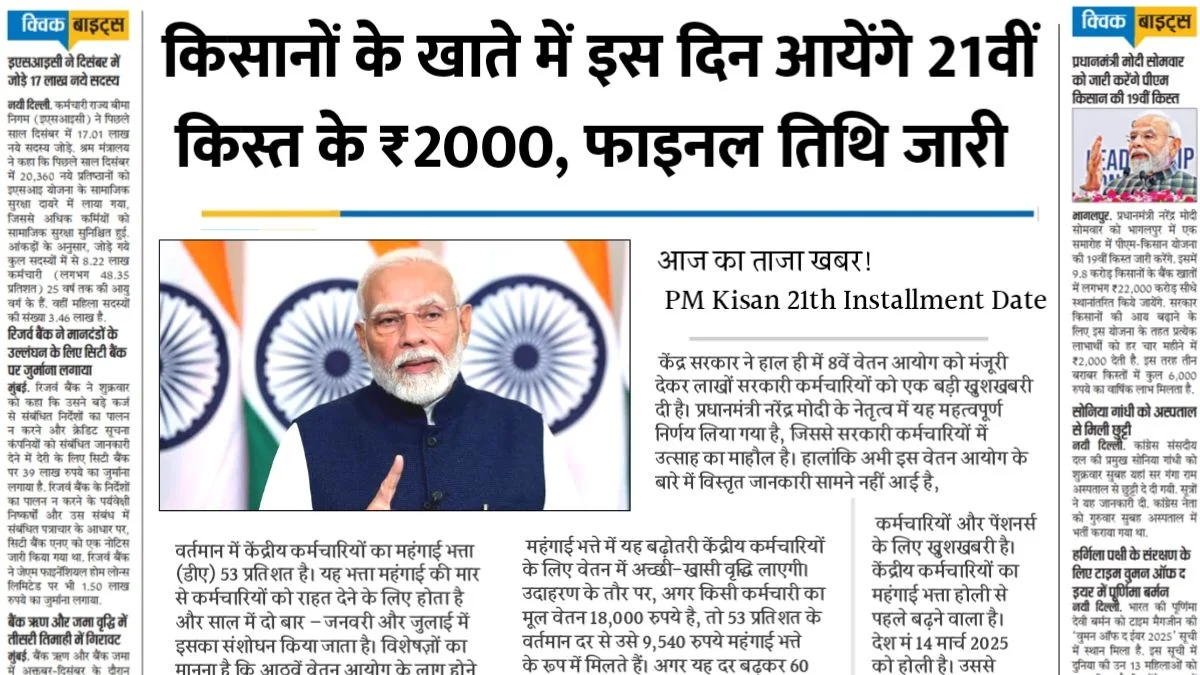
When will the 21st installment of the PM Kisan Yojana arrive?
The government releases one installment every four months. The 20th installment was released some time ago. Now, all farmers have the same question:
When will the 21st installment arrive?
Although the government has not yet announced an official date, based on previous installments, it is estimated that:
Between November 15th and November 20th
The 21st installment may be credited to farmers’ bank accounts.
Sometimes, the government releases installments during special events where the Prime Minister or the Agriculture Minister interacts with farmers. Therefore, farmers are advised to keep an eye on news and the official website.
Things to consider to receive your installment on time
Many farmers’ installments are delayed simply because their documents are not updated or their eKYC is incomplete. Therefore, it is important to complete these steps in a timely manner.
Farmers must complete these things:
- eKYC must be complete
Mobile number must be linked to Aadhaar. Without eKYC, installments are stopped. - Bank account must be active and linked to Aadhaar.
- Land records must be correct.
The name in the Khasra, Khatauni, and land records must be the same as the one in the application. - There must be no mistakes in the spelling of the name, Aadhaar number, bank account number, and IFSC code.
Sometimes, even a small mistake, such as a single misspelled letter in the name, can result in the installment being withheld. Therefore, it is best for farmers to check their documents promptly.
What is the eligibility for the PM Kisan Yojana?
Not all farmers are eligible for the benefits of this scheme. There are certain conditions:
- The farmer must own a maximum of two hectares of land.
- No member of the family must be in a government job.
- If the farmer pays income tax, they cannot avail the benefits.
- Farmers who rent or sharecrop land are not eligible for this scheme.
- The farmer’s annual income should not exceed the government-set limit.
The primary objective of this scheme is to provide assistance only to small and economically vulnerable farmers, which is why these rules have been established.
How to Check the Status of Your 21st Installment
Many farmers repeatedly visit the bank to check if the money has arrived. But there’s no need to do so. You can check the status of your installment in a few minutes using your mobile phone or the village CSC center.
The method is as follows:
- Open the pmkisan.gov.in website
- Go to the Farmer’s Corner
- Select the “Beneficiary Status” or “Know Your Status” option.
- Enter your registration number.
- If you don’t remember your registration number, you can also get the information through your mobile number.
- Receive the OTP.
- Enter the OTP and submit.
Upon completing this process, the screen will display your details. Whether the installment arrived, when it arrived, how much it arrived, and whether any installments are pending.
What to do if your installment doesn’t arrive
Sometimes, some farmers’ installments are delayed or not received at all. There can be several reasons for this, such as:
- Incomplete eKYC
- Error in bank account
- Incorrect Aadhaar number
- Bank account closure
- Document mismatch
In such a situation, you should take these steps:
- First, check the status on the website.
- If eKYC is incomplete, complete it immediately.
- Go to the bank and check your account status.
- Go to a CSC center or agriculture office to make corrections.
- After the corrections are completed, the benefit is received in the next installment.
The government does not withhold the installment for any eligible farmer; the documents must be correct.
How has the PM Kisan Yojana impacted the lives of farmers?
This scheme has helped rural farming families in many ways.
- Crop preparation is now on time.
- Farmers have less need to borrow from private lenders.
- It helps them purchase agricultural equipment.
- The burden of farming is eased.
Many farmers reported that this money has significantly facilitated their cultivation of wheat, paddy, mustard, pulses, and vegetables. Small farmers, in particular, value this money greatly, as they have limited sources of additional income.
Disclaimer
This article is prepared for educational and informational purposes only.
The exact date of the 21st installment depends on government decisions, so always check the official website pmkisan.gov.in or contact the nearest agriculture office for final confirmation.